

Pure, sustainable extracts are set to redefine the natural products landscape in 2025, as more brands and researchers seek cleaner, greener solutions. Supercritical extraction stands out as a breakthrough method, using unique fluid properties to deliver high-purity, potent extracts without harsh chemicals.
In this guide, we unpack the essentials of supercritical extraction, from core principles and step-by-step processes to advanced techniques and industry applications. You’ll discover how this innovative method empowers New Zealand botanical producers, like those crafting premium mānuka extracts, and what it means for your business or research.
Ready to unlock the future of efficient, eco-friendly extraction? Let’s dive in.
Understanding Supercritical Extraction: Fundamentals and Principles
Supercritical extraction is changing the way we capture the purest and most valuable natural compounds. This process uses fluids pushed beyond their normal limits, unlocking a unique state where they act like both a gas and a liquid. In New Zealand, the method is especially valued for extracting mānuka’s rare bioactives, keeping them potent and sustainable.
What is Supercritical Extraction?
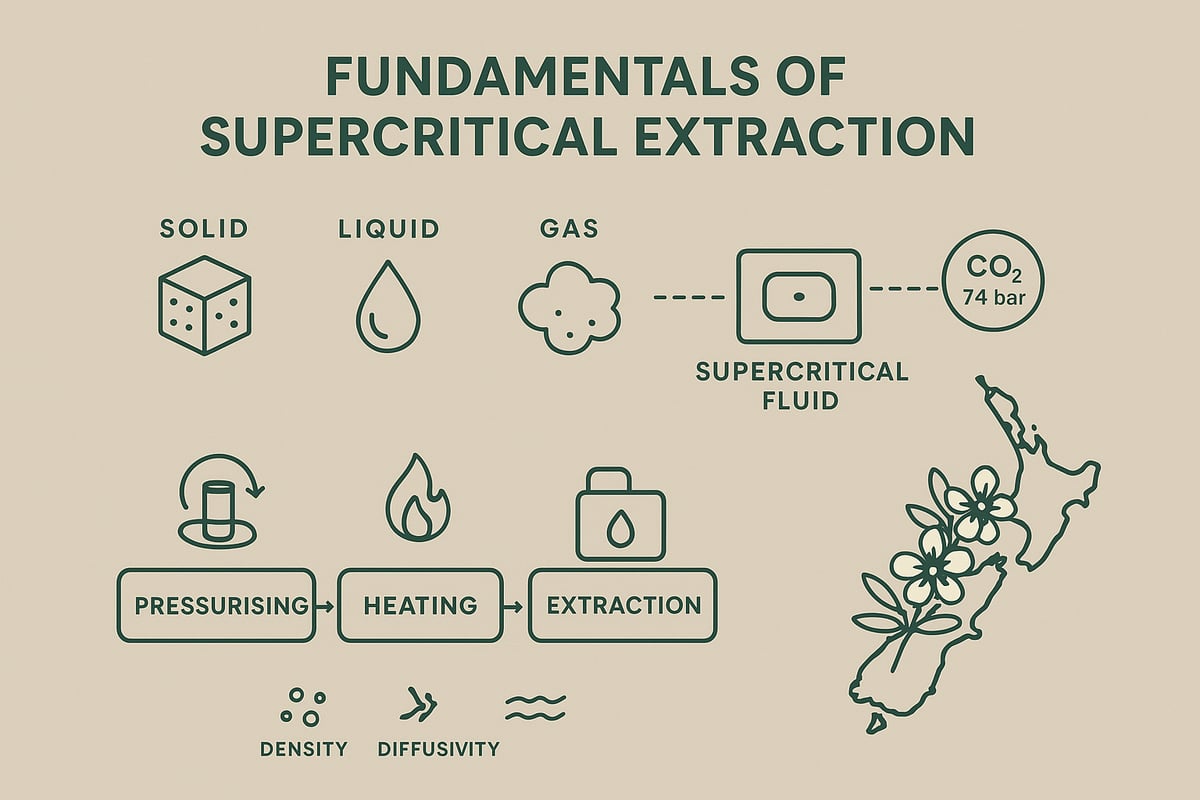
Supercritical extraction is a cutting-edge separation technique that uses supercritical fluids—substances at a temperature and pressure above their critical point. In this state, a fluid's density is similar to a liquid, but its viscosity and diffusivity are closer to a gas. This unique combination gives supercritical fluids exceptional solvating power, allowing them to dissolve a wide range of natural compounds.
The most commonly used supercritical fluid is carbon dioxide (CO₂). It becomes supercritical at just 31°C and 74 bar, making it efficient, safe, and accessible for many industries. Water is also used, especially for extracting certain antioxidants, but requires higher pressures and temperatures. Other gases like nitrous oxide or propane are much less common, mainly due to safety and regulatory reasons.
The concept of supercritical extraction dates back to 1879 when Hannay and Hogarth observed unusual solubility in supercritical fluids. The real boom, however, came in the 1980s as industries sought cleaner, greener extraction methods. Compared to traditional solvents, supercritical extraction offers significant environmental and safety benefits, especially since CO₂ is non-toxic, non-flammable, and can be recycled within the process. For a more detailed explanation of the science behind supercritical fluids, see this Supercritical Fluid Extraction Overview.
How Supercritical Extraction Works
The supercritical extraction process begins by pressurising a fluid, typically CO₂, and cooling it to maintain control. The fluid is then heated above its critical temperature and pressure, entering the supercritical state. At this point, the supercritical CO₂ is passed through a vessel containing the natural material, such as mānuka leaves or coffee beans.
Inside the vessel, the supercritical fluid acts as a powerful solvent, dissolving targeted compounds from the plant matrix. By adjusting the temperature and pressure, operators can fine-tune which compounds are extracted, offering remarkable selectivity. Adding a small amount of a modifier, like ethanol, can further boost the extraction of polar compounds, expanding the range of bioactives that can be captured.
A classic example is the decaffeination of coffee. Supercritical CO₂ dissolves caffeine while leaving flavour compounds largely untouched, resulting in a high-quality, chemical-free decaf product.
Key Advantages Over Conventional Extraction
Supercritical extraction comes with a host of advantages over traditional solvent-based methods:
- Faster processing times: Extraction can be completed in 10–60 minutes, compared to several hours for conventional methods.
- Higher selectivity and tunability: Operators can target specific compounds by tweaking pressure and temperature.
- Reduced waste: Solvent recovery and recycling are built into the process, minimising environmental impact.
- Gentle on sensitive compounds: Lower extraction temperatures protect delicate bioactives, such as mānuka antioxidants and essential oils.
- Food-grade safety: CO₂ is non-toxic and leaves no harmful residues.
Research shows supercritical extraction can increase both yield and purity by up to 30 percent compared to solvent extraction. This makes it a preferred choice for industries seeking greener, cleaner, and more effective extraction solutions.
Step-by-Step Guide to Supercritical Extraction: Equipment and Process
Setting up a successful supercritical extraction process starts with understanding each piece of the puzzle. Whether you’re extracting mānuka from native New Zealand botanicals or working with global ingredients, the right tools and careful process design are crucial for purity and yield.
Core Components of a Supercritical Extraction System
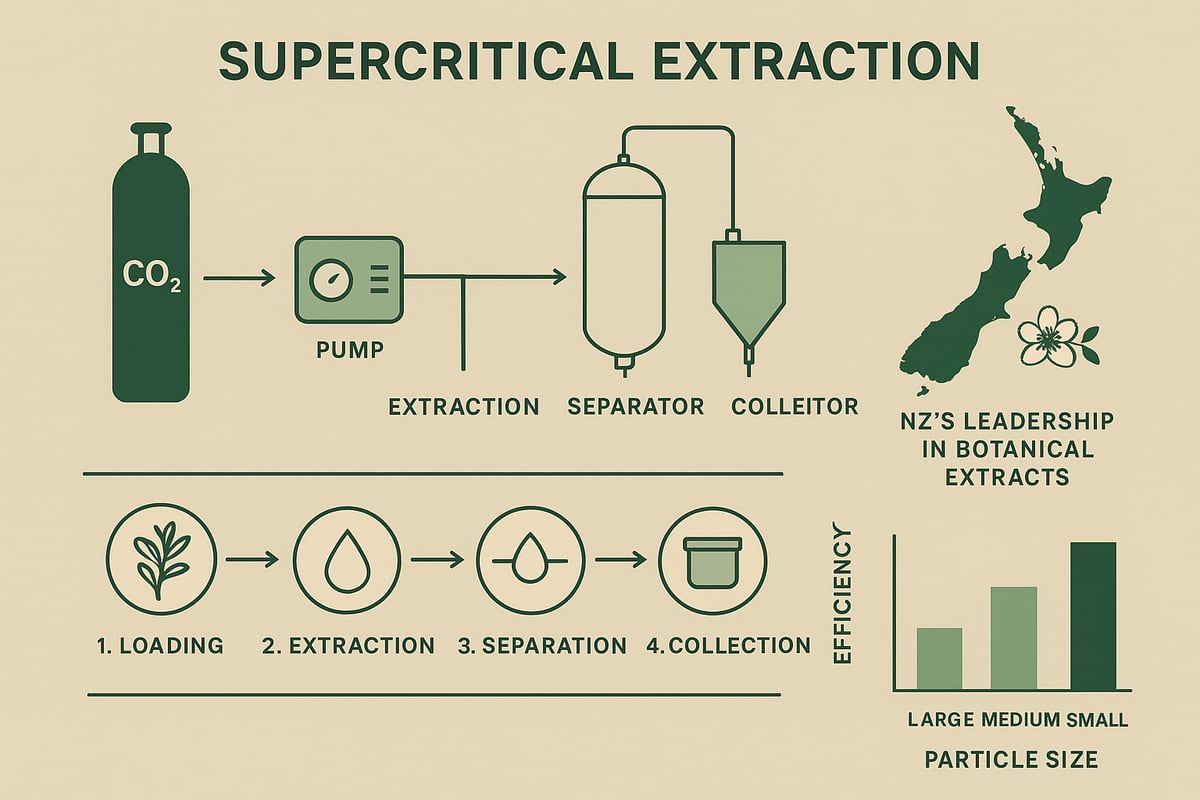
Every supercritical extraction system is built for precision and safety. The key components work together to maintain the delicate balance of pressure and temperature needed for effective extraction.
- Fluid reservoir: Typically a CO₂ gas cylinder, delivering the starting material for the supercritical extraction process.
- Pumps: Reciprocating, syringe, or diaphragm pumps create the necessary high pressure for both small and large batches.
- Extraction vessel: Stainless steel chambers rated for 300–800 bar, designed to hold the botanical or plant matrix during extraction.
- Restrictors: Both fixed and variable types, including back pressure regulators, control the flow and pressure throughout the system.
- Collector/trapping system: Captures separated solutes after extraction.
- Detectors: Analytical setups may use flame ionisation detectors for monitoring.
- Heating/cooling systems: Ensure the CO₂ remains at supercritical conditions during the entire process.
Each part is essential for maintaining the high standards required for extracting bioactive compounds, such as those found in premium mānuka extracts.
Chronological Extraction Procedure
A successful supercritical extraction follows a stepwise approach. Here’s how the process unfolds:
1. Prepare your sample: Optimise particle size, moisture, and surface area for the botanical (e.g., mānuka leaf).
2. Load the sample: Place it into the high-pressure extraction vessel.
3. Pressurise and cool CO₂: Use the pump to reach the desired pressure, maintaining low temperatures.
4. Heat to supercritical state: Elevate temperature so CO₂ becomes a supercritical fluid.
5. Begin extraction: Supercritical CO₂ flows through the sample, dissolving target compounds.
6. Depressurise and collect: Reduce pressure in a separator, causing solutes to precipitate and be collected.
7. Recycle solvent: Recover and repressurise CO₂ for sustainable operation.
Adjustments at each step enable fine-tuning for different extracts. For a deeper look at the real-world process behind mānuka extraction in New Zealand, see Our Extraction Process Explained.
Factors Affecting Extraction Efficiency
Several variables influence how well supercritical extraction performs. Getting these right can boost yields and purity, especially for sensitive New Zealand botanicals.
- Pressure and temperature: Fine-tune to target specific compounds.
- Flow rate: Impacts how quickly extraction occurs.
- Co-solvent addition: Introducing modifiers like ethanol can help extract polar compounds.
- Sample matrix: Particle size, porosity, and morphology matter. Smaller particles can increase extraction rates by up to 40%.
- Extraction mode: Choose static (no flow) or dynamic (continuous flow) based on your goals.
Here’s a quick summary:
| Factor | Effect on Extraction |
|---|---|
| Higher pressure | Increases solvating power |
| Higher temp | Improves diffusion, may lower solubility for some |
| Smaller particles | Boosts extraction rate |
| Co-solvent | Enhances polar compound recovery |
Safety and Maintenance Considerations
Safety is non-negotiable in supercritical extraction. High-pressure systems demand robust vessel design and certified pressure ratings. The Joule-Kelvin effect, where rapid expansion cools the system, must be managed with reliable heating and cooling controls.
Regular pump and restrictor maintenance helps prevent blockages, ensuring consistent operation and protecting both staff and product quality. For those working with mānuka and similar botanicals, attention to safety protects your investment and supports sustainable, long-term extraction success.
Advanced Techniques and Optimisation Strategies for 2025
As supercritical extraction technology evolves, businesses and researchers in New Zealand are unlocking new levels of efficiency, sustainability, and product quality. Whether you aim to refine mānuka extracts or scale up botanicals for export, staying ahead with advanced methods is essential. Let’s explore the latest techniques shaping the future of supercritical extraction.
Recent Innovations in Supercritical Extraction
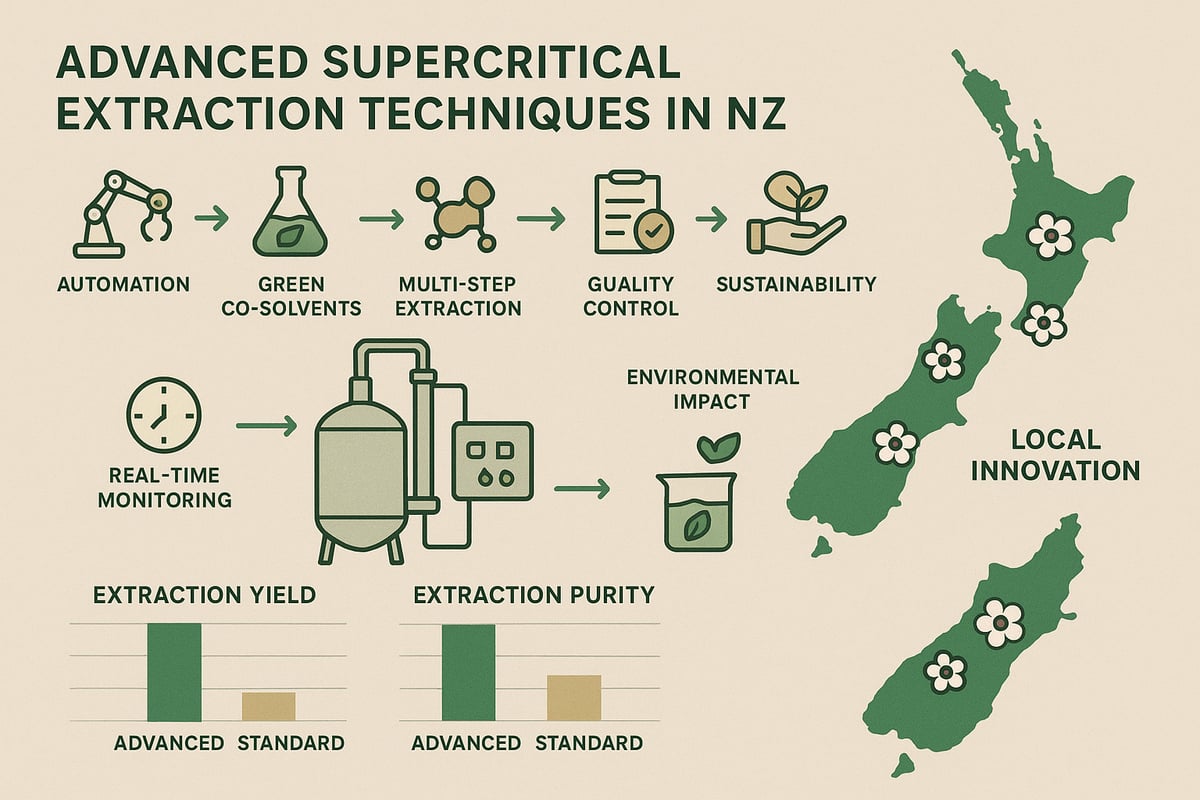
The field of supercritical extraction is advancing rapidly, especially with new automation and process control solutions. Automated systems now monitor pressure and temperature in real time, ensuring consistent results even for complex botanicals like mānuka from New Zealand. Another breakthrough is the use of green co-solvents such as ethanol, which improves selectivity and sustainability for extracting polar bioactives.
Multi-step and fractionated extraction methods allow for separation of different compound groups in a single process. For example, mānuka extracts can be fractionated to isolate unique triketones and antioxidants. These innovations are making it easier to produce full-spectrum extracts with higher yields and purity. For a deep dive into these advances, see Recent Advances in Supercritical Fluid Extraction.
Optimising Extraction Parameters
Getting the most from supercritical extraction requires careful adjustment of key process variables. By increasing temperature and agitation, diffusion rates improve, helping to draw out more of the desired compounds. Raising pressure or adding a co-solvent like ethanol can enhance the solubility of target molecules, especially in dense botanicals like mānuka.
Flow rate is crucial for both small-batch and continuous systems. Optimising this parameter supports efficient scale-up, vital for commercial production. For example, when extracting polyphenols from wine waste, sequential pressure adjustments can boost both yield and selectivity.
Here’s a quick summary:
| Parameter | Effect on Extraction |
|---|---|
| Pressure | Increases solubility |
| Temperature | Boosts diffusion |
| Co-solvent | Enhances selectivity |
| Flow Rate | Impacts efficiency |
Quality Control and Analytical Verification
Ensuring the quality and consistency of supercritical extraction products is non-negotiable. Chromatography and spectroscopy are standard tools for assessing purity and verifying the presence of key bioactives. For mānuka extracts, these analytical methods confirm that triketones and antioxidants are retained at optimal levels.
Maintaining batch-to-batch consistency is crucial for commercial success. Supercritical extraction can achieve over 95% purity for certain essential oils, making it a preferred method for high-value natural products. This rigorous approach is especially important for New Zealand producers targeting international markets with premium mānuka extracts.
Sustainability and Environmental Impact
Supercritical extraction stands out for its sustainability advantages. Unlike traditional solvent-based methods, it generates far less hazardous waste, as most solvents (like CO2) are recyclable. This not only cuts costs but also aligns with global environmental goals.
Energy consumption is lower thanks to closed-loop solvent recovery. For New Zealand businesses, this means a smaller environmental footprint and a stronger position in the growing market for sustainable, natural products. By embracing supercritical extraction, Waiou Extracts support both ecological stewardship and economic growth.
Industry Applications: Food, Pharmaceuticals, Cosmetics, and Beyond
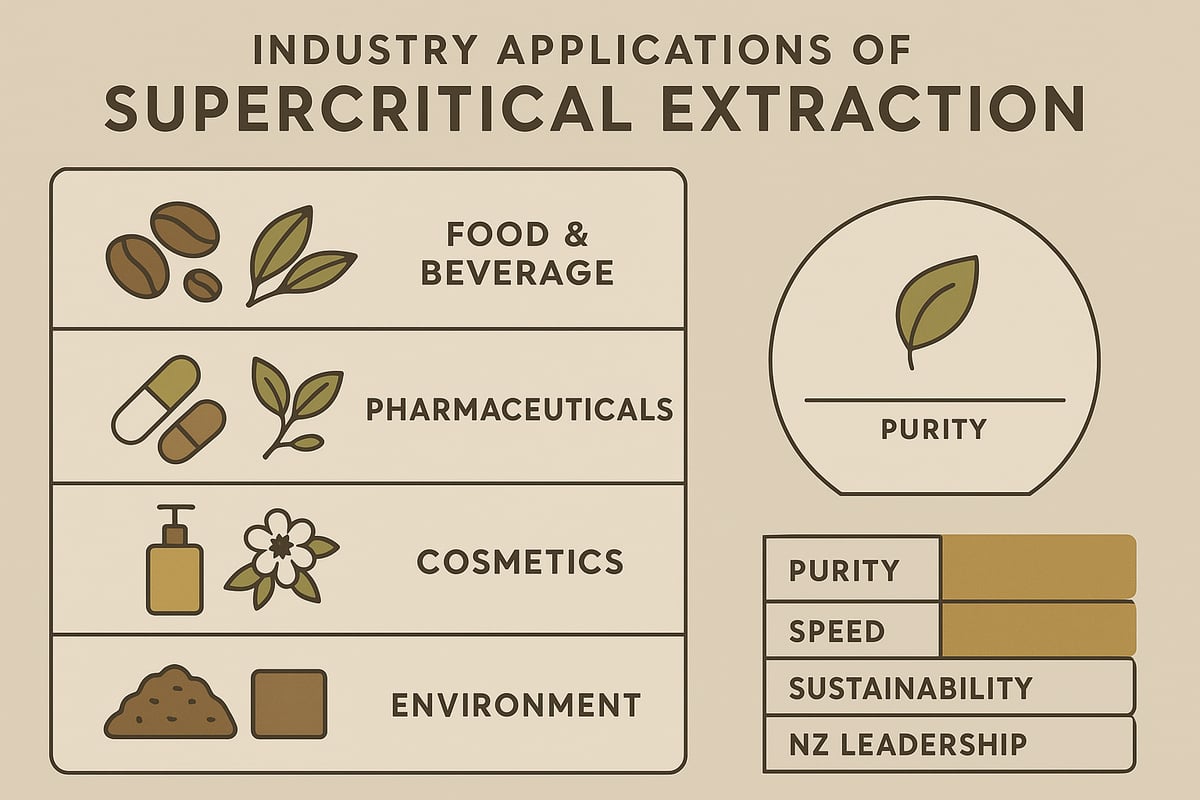
Supercritical extraction is transforming industries across New Zealand and the globe, offering a cleaner, more efficient way to unlock nature’s most valuable compounds. Let’s explore how this technology is reshaping food, wellness, and environmental sectors, with a special look at mānuka’s journey from bush to bottle.
Food and Beverage Industry
Supercritical extraction has revolutionised the way we process coffee, tea, and natural flavours. This method allows for precise decaffeination, ensuring coffee and tea retain their full-bodied taste. It’s also the gold standard for extracting essential oils like limonene and vanilla, offering unmatched purity.
In fact, supercritical CO₂ is now used in over 60 percent of global decaffeination plants, greatly reducing the need for harsh solvents. If you’re curious about the science behind this, the Supercritical Fluid Extraction in the Food Industry provides a deeper look at how this technique is shaping food innovation.
- Decaffeination of coffee and tea
- Extraction of essential oils and flavours
- Removal of pesticides and contaminants
This approach not only delivers cleaner products but also supports New Zealand’s push for sustainable food processing.
Pharmaceuticals and Nutraceuticals
The pharmaceutical and nutraceutical sectors rely on supercritical extraction to obtain pure, potent compounds from medicinal plants. This technique isolates active ingredients like cannabinoids and terpenes from hemp, ensuring high efficacy and safety.
Supercritical extraction is also used for producing premium nutraceuticals and supplements, meeting strict regulatory standards. For a comprehensive overview, see the Supercritical Extraction of Bioactive Substances, which details the method’s ability to capture delicate plant actives.
- Isolation of therapeutic compounds
- High-purity supplements
- Consistent quality for commercial products
This clean-label approach aligns perfectly with the growing demand for natural health solutions.
Cosmetics and Personal Care
In the cosmetics industry, supercritical extraction is prized for its ability to capture the full spectrum of bioactive compounds. Natural antioxidants, pigments, and fragrances are extracted at low temperatures, preserving their potency for sensitive skin formulations.
Mānuka extract, sourced through supercritical extraction in New Zealand, is a standout. Its rich blend of antioxidants and antibacterial agents makes it ideal for soothing eczema, acne, and sensitive skin. This method ensures every drop stays true to the plant’s natural power.
- Extraction of natural fragrances and pigments
- Gentle preservation of bioactives
- Full-spectrum mānuka for advanced skincare
Supercritical extraction delivers products that are both effective and gentle, a win for conscious consumers.
Environmental and Industrial Applications
Supercritical extraction isn’t just for food and beauty. It’s a game changer for environmental remediation and resource recovery, too. Companies use it to clean contaminated soils, recycle solvents, and even extract rare earth elements and precious metals.
In industrial settings, supercritical extraction can reduce solvent emissions by up to 90 percent, helping New Zealand businesses meet tough environmental standards.
- Soil and waste stream cleanup
- Recovery of metals and minerals
- Dramatic reduction in solvent waste
This technology supports a cleaner, greener future across multiple sectors.
Case Study: Full Spectrum Botanical Extraction in New Zealand
New Zealand is leading the way with sustainable botanical extractions, and mānuka is at the heart of this movement. Kiwis use supercritical extraction to capture the full range of mānuka’s beneficial compounds, from antioxidants to antibacterial agents.
Waipu Extracts is a prime example, delivering a world-first Full Spectrum Mānuka Extract. Their proprietary process ensures all-natural, locally sourced ingredients, offering rapid relief for skin concerns like eczema and acne. Customers rave about the results, with a 4.9 out of 5 satisfaction rating.
By choosing supercritical extraction, New Zealand producers achieve higher efficacy and purity compared to traditional methods, while championing sustainability and native plant stewardship.
Commercialisation, Trends, and Future Outlook for Supercritical Extraction
The commercialisation of supercritical extraction is accelerating as global industries seek cleaner, more efficient extraction solutions. Scaling up from lab to commercial production requires careful investment in high-pressure equipment, process validation, and ongoing staff training. Market trends show a rising demand for clean-label, solvent-free extracts across food, wellness, and cosmetics, with the worldwide supercritical extraction market projected to surpass NZ$1.2 billion by 2025. New Zealand producers are well placed to capture this growth, especially with the surge in natural mānuka extract applications.
Regulatory and Quality Standards
Supercritical extraction must meet strict international standards for purity, safety, and traceability. For food, pharmaceutical, and cosmetic applications, compliance with FSANZ, TGA, and EU regulations is essential. These standards ensure that extracts, like New Zealand’s mānuka, are free from contaminants and meet consumer expectations for quality. Batch testing, documentation, and transparent sourcing all support the credibility and global marketability of supercritical extraction products.
Emerging Trends and Innovations
Innovation is reshaping supercritical extraction in 2025. Automation and AI-driven controls are streamlining process optimisation, boosting both yield and quality. The adoption of renewable energy and green co-solvents is making extraction more sustainable and cost-effective. Fractionated and multi-step extraction methods are unlocking new possibilities, enabling producers to isolate full-spectrum bioactive profiles from botanicals like mānuka. For deeper technical insights, explore the Library of Extraction Knowledge.
Challenges and Solutions
Despite its advantages, supercritical extraction faces challenges such as high upfront capital costs and technical difficulties when extracting polar compounds. Solutions include partnering with research institutions to develop hybrid systems, and using co-solvents to widen the extractable range. Equipment maintenance and staff training are also crucial for safe, consistent operation. Overcoming these hurdles ensures a strong return on investment and long-term sustainability for businesses.
Future Opportunities in New Zealand and Globally
New Zealand’s unique flora, advanced research, and commitment to sustainability position it as a leader in supercritical extraction. Local producers are accessing global markets by offering high-value, natural extracts, with mānuka products drawing international attention. Export data suggests NZ botanical extracts will grow by 20 percent annually through 2025. As the world seeks greener solutions, supercritical extraction opens doors for innovation, commercial success, and a healthier planet.
If you’re feeling inspired by the incredible benefits of supercritical extraction and curious about how these breakthroughs can make a real difference for your skin, you’re not alone. We know how important it is to find natural, effective solutions that actually work—especially when dealing with tough conditions like eczema or acne. At Waipu Extracts, we use our world-first Full Spectrum Mānuka Extract and advanced extraction techniques to deliver the best of mānuka’s natural power, right to you. If you’re ready to experience high-quality, science-backed skincare, you can Get Your Mānuka Extract Today.